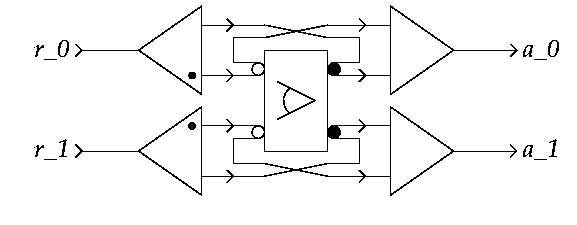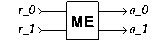
The four phases of a handshake with a Mutual-Exclusion Element can be interpreted as request, grant, done, and acknowledge (of done) respectively. The grant outputs on the ports are mutually exclusive.
When a Mutual-Exclusion Element receives two requests, it will grant exactly one of them (and delay the other). The specification leaves the choice open. Often there is a fairness requirement on this choice: if a choice situation arises `infinitely often' then both requests are granted `infinitely often'.
Specification in Verdect:
define ME( r0?, a0!, r1?, a1! ) =
   |[  x0, y0, x1, y1 ::
       pref *[ r0?; x0; a0!; r0?; y0; a0! ]
   ||  pref *[ r1?; x1; a1!; r1?; y1; a1! ]
   ||  pref *[ x0; y0 | x1; y1 ]
   ]|
end
Also available through this link
Specification in DI Algebra:
I = { r0, r1 }
O = { a0, a1 }

ME = [ r0? -> a0! ; r0? ; a0! ; ME
     , r1? -> a1! ; r1? ; a1! ; ME
     ]
Also available through this link
This is shown by this
report.
An alternative specification in DI Algebra uses alternations:
Specification in DI Algebra:
I = { r0, r1 }
O = { a0, a1 }

ME = [ r0? -> a0! ; r0? ; a0!; ME
     , r1? -> a1! ; r1? ; a1!; ME
     ]
[{r0},{a0}]
[{r1},{a1}]
Also available through this link
This comparison
shows that this specification
is correct.
The roles of the two ports can be interchanged:
ME(a, b) = ME(b, a)
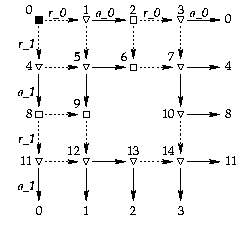
A Mutual-Exclusion Element is not output deterministic, since there is an output choice in state 5. The output nondeterminism is dynamic.
No information available
No information available
No information available